AI-Native GCC: Redesigning Work, Roles and Learning for 2030

How GCC leaders can move beyond automation shock to build genuinely AI-native operating models — redesigning work, roles, and learning as a single connected system for 2030 and beyond.
The AI-Native GCC: Redesigning Work, Roles, and Learning to Survive Automation Shock
Why deploying AI tools without redesigning roles, behaviours, and learning systems produces automation shock — and how CXOs can build an AI-native GCC operating model that compounds value rather than compounds risk
Abstract
Global Capability Centres are entering a phase where AI no longer arrives as a side project. It arrives inside the ticket queue, the reporting cycle, the code review, and the daily operating rhythm of every function. Most GCCs are responding with isolated automation pilots that quietly displace tasks without redesigning the roles, behaviours, and learning systems built around them. This article distinguishes that pattern — automation shock — from a deliberate AI-native operating model, in which work, roles, and capability-building are redesigned together.
It introduces five emerging role archetypes, a framework for human-centred task redesign, an embedded learning architecture, and the behavioural guardrails and governance structures that allow GCC leaders to scale AI without losing the workforce trust that sustains adoption across multiple capability cycles.
1. Automation Shock Is Here: The Pattern Repeating Across GCCs
Across Global Capability Centres, the same pattern is repeating in finance operations, IT service desks, HR shared services, and analytics hubs. A copilot drafts the first version of a report. An agent triages and resolves a growing share of level-one tickets. A code-generation tool produces the scaffolding a junior engineer used to write by hand. Individually, each change looks like a productivity win. Collectively, they describe something larger: the task composition of GCC work is shifting faster than the roles, career paths, and management routines built around it.
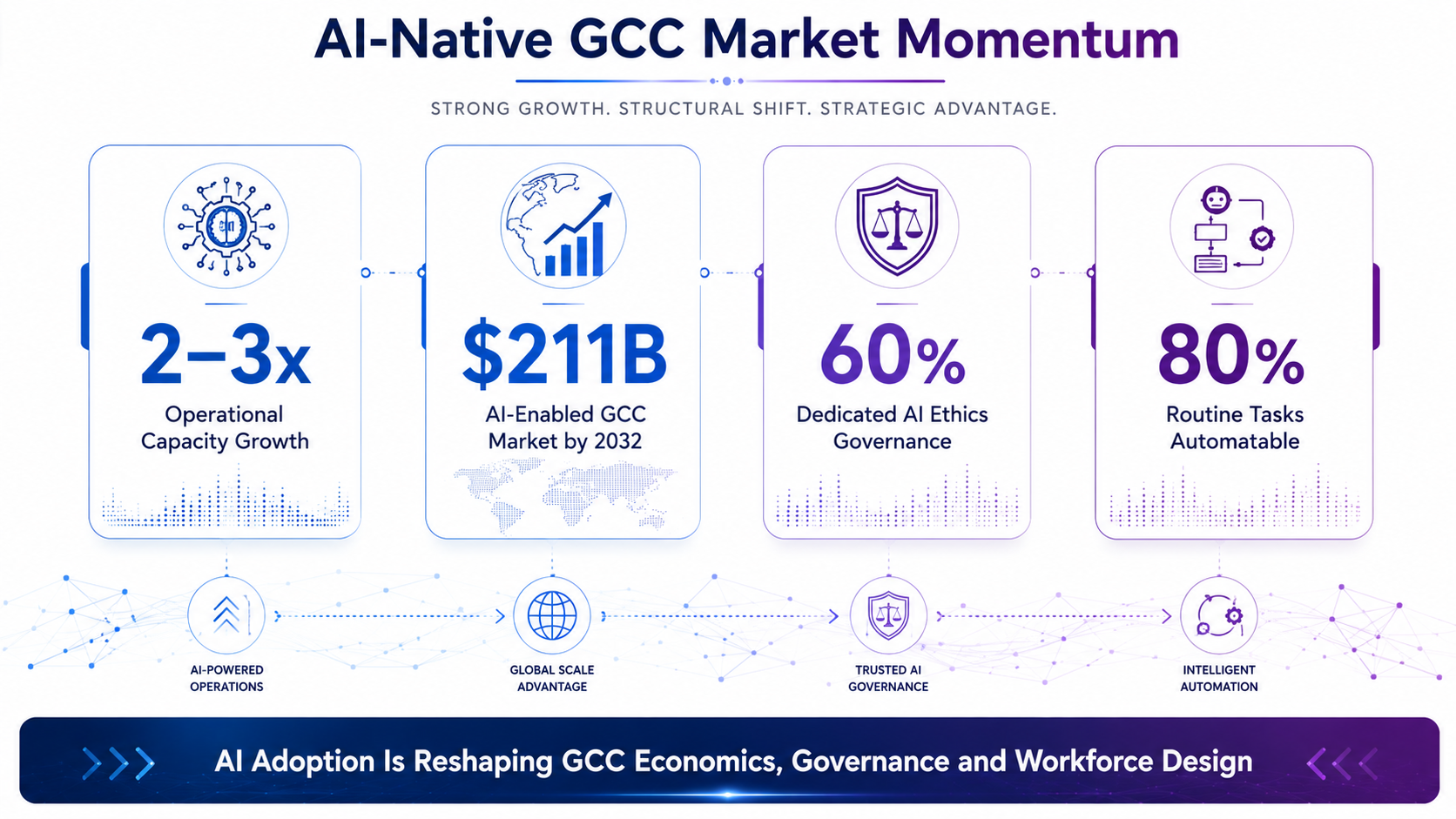
Industry data confirms the pace. Leading GCCs running integrated automation platforms are reporting 2 to 3 times capacity scaling without proportional headcount growth, 40 to 60 percent efficiency gains, and error reductions of up to 70 percent in high-volume processes. By 2026, roughly 60 percent of GCCs are expected to have a dedicated AI ethics and compliance governance function — a sign that boards already anticipate the behavioural and risk questions this shift creates.
"An AI-native GCC is not one that has deployed more AI tools than its peers. It is one that has redesigned work, roles, behaviours, and learning as a single system — so that automation expands what the centre delivers instead of quietly hollowing out the roles inside it." — GCC AI Workforce Research, 2026 |
This is automation shock: rapid, often piecemeal deployment of AI capability inside existing roles, with no corresponding redesign of what those roles are for, what new judgment they require, or how people are expected to grow into them. It produces two predictable failure modes: fear-driven resistance, where employees quietly slow-walk adoption because no one has been honest about what changes; and the short-term automation play, where leadership chases visible efficiency wins without asking what the operating model should look like once the dust settles. Both leave capacity on the table and trust on the floor.
2. What Does "AI-Native" Actually Mean for GCCs?
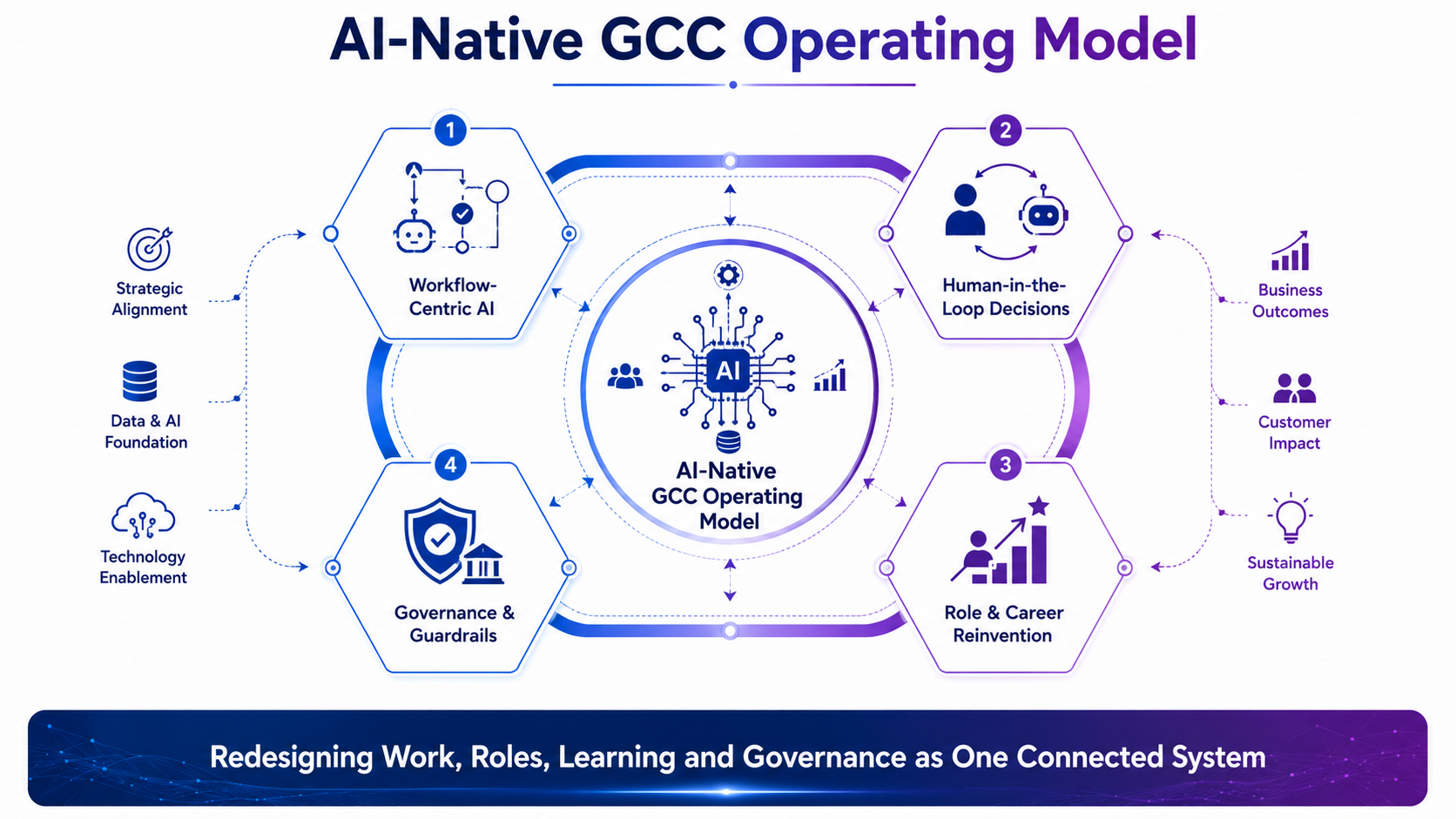
"AI-native" is frequently used as a synonym for heavy AI tool adoption. That definition misses the point and, in practice, is exactly what produces automation shock. A centre can deploy dozens of copilots, bots, and agentic workflows and still be operating on an essentially unchanged operating model. AI-native describes an operating model, not a technology stack. A GCC earns the description when four characteristics are simultaneously true:
• AI is embedded in workflow design, not layered on top of it. Processes are re-architected around what AI and humans each do best, rather than AI inserted as a faster version of an existing manual step.
• Human-in-the-loop decision points are structured and explicit. Every workflow touching AI output has a defined checkpoint — who reviews, what triggers escalation, and what "good enough to act on" means for that task.
• New roles and career paths exist for the capability AI creates, not only for the capability it removes. Redeployment is planned, not improvised after the fact.
• Guardrails are operational, not aspirational. Bias checks, override rights, and escalation norms are built into daily routines and measured — not confined to a policy document no one revisits after launch.
The distinction matters commercially as much as culturally. The AI-enabled GCC market is projected to grow from roughly $33 billion in 2023 to over $211 billion by 2032 — a trajectory that rewards centres able to absorb new capability quickly and credibly, and penalises those whose workforce treats every new release as a threat to resist rather than a capability to redesign around.
3. Five Role Archetypes Emerging in AI-Native GCCs
Role redesign is the part of AI-native transformation most organisations skip. Five archetypes are emerging consistently across GCCs that have moved past pilot stage. None are entirely new job titles bolted onto the org chart — most grow out of existing analyst, operations, and product roles, reshaped around a new mix of tasks and judgment.
Archetype | Core Function and Emergence Path |
AI-Augmented Analyst | No longer spends bulk of time assembling data or drafting first-pass reports — AI does that. Value shifts to framing the right question, validating model output against business context, and translating analysis into actionable decisions. Requires comfort interrogating AI output rather than accepting it, and enough domain depth to recognise when an answer is technically correct but practically wrong. |
Citizen Automator | Operations staff — not engineers — who use low-code and AI-assisted tools to automate their own workflows. Typically the people who understood the manual process best. Requires accessible tooling, lightweight governance to prevent shadow IT, and a recognition structure that rewards process improvement, not just execution. |
AI Product Owner | Manages an AI capability the way a product manager manages a product — with a roadmap, success metrics, a feedback loop with end users, and explicit accountability for whether the workflow is improving outcomes rather than simply running. Emerges as GCCs move from individual automations to portfolios of AI-enabled workflows. Unlock the Full ResearchCreate a free account or sign in to access the complete methodology, deep-dive analysis, and key implementation frameworks. Don't have an account? It's free to join. O Organization Learning LabsResearch & Insights Division On this pageResearch DetailsIndustryGCC Leadership & Governance AuthorOrganization Learning Labs PublishedJun 24, 2026 You Might Also Be Interested In Information Technology Designing the future-ready digital engineering organization Banking, Financial Service And Insurance A Systematic, Empirical Framework for Capability Development in Retail Banking Banking, Financial Service And Insurance Why Capability Beats Strategy in Retail Banking Organizations |
Comments