Advanced Therapies: Building ATMP-Ready Teams in Pharma Now

Cell and gene therapy is scaling fast, but 90% of ATMP firms report skill shortages. Learn how pharma builds ATMP-ready teams for the vein-to-vein journey.
Advanced Therapies, Advanced Skills: Building ATMP-Ready Teams in Pharma
The pharmaceutical industry is approaching a structural inflection point in ATMP workforce readiness. Advanced Therapy Medicinal Products (ATMPs) are no longer confined to academic laboratories or early-stage trials. They are moving steadily toward commercial-scale production, and in doing so, they are exposing a workforce challenge unlike anything the sector has faced before.
ATMPs are fundamentally different from conventional medicines. They are living therapies: gene therapies that correct faulty DNA, CAR-T cell treatments engineered from a patient's own immune cells, and tissue-engineered products designed to regenerate damaged organs. In many cases, each batch treats a single individual. Every step must be executed flawlessly, from the moment biological material leaves a patient's body to the moment it returns, a process the industry describes as the vein-to-vein journey. The science is advancing rapidly. Workforce readiness is not keeping pace.
The ATMP Boom, and the Talent Bottleneck
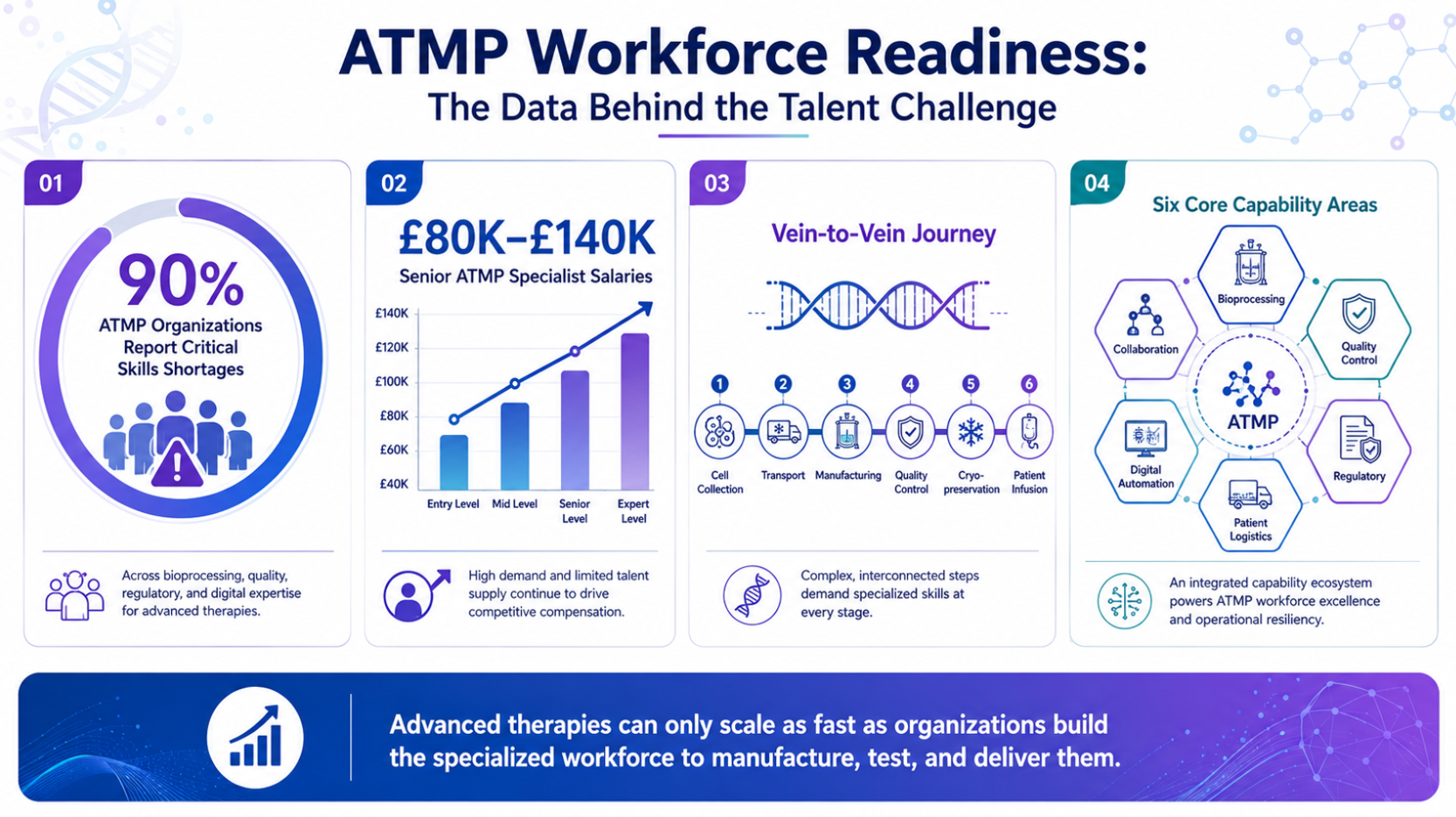
The growth trajectory of cell and gene therapies is unmistakable. Investment has surged, clinical pipelines have expanded, and regulatory approvals are accelerating. Fresh 2026 UK labour-market data illustrates the scale of the shift: cell and gene therapy roles now command salary premiums well above the wider biotech sector, with senior specialists and Qualified Persons commanding £80,000 to £140,000, and nearly all cell and gene therapy companies surveyed report they are actively expanding their workforce.
Yet this expansion masks a critical constraint. Nearly 90% of ATMP industry professionals report significant shortages of skilled personnel within their organizations. The challenge is not simply filling open roles. It is a mismatch between what existing training pipelines produce and what ATMP manufacturing actually requires. Industry surveys reveal gaps across foundational theoretical knowledge, hands-on technical expertise, and, unexpectedly, soft skills such as teamwork, critical thinking, and cross-functional collaboration. As one industry expert observed, the workforce bottleneck reflects the sheer rapidness of the evolution taking place in cell and gene therapy. Universities and traditional pharmaceutical training programs have struggled to keep pace with a field that did not exist in its current form a decade ago.
Importantly, the most acute shortages are not at the level of senior researchers. Demand is strongest for technical laboratory staff, biomanufacturing specialists, quality professionals, and regulatory experts who understand the operational realities of working with living, patient-specific products, roles that traditional pharma degree programmes were never designed to produce at scale.
Why Standard Pharma Skills Don't Transfer
To understand why ATMP talent is so scarce, it is necessary to understand how radically ATMP manufacturing departs from conventional pharmaceutical production.
Small batches, high stakes. Traditional pharmaceuticals are produced in large batches, yielding thousands or millions of identical doses. Many ATMPs invert this logic entirely. Autologous therapies such as CAR-T are manufactured at a batch size of one: cells taken from Patient A are modified and returned exclusively to Patient A. Errors are not simply costly; they can be fatal. As a result, traceability is not a regulatory add-on but the backbone of the entire manufacturing process.
Patient-specific processes. Each patient's biological starting material behaves differently. Manufacturing protocols must accommodate variability while remaining compliant with regulatory requirements. Operators need not only technical proficiency but judgment, an ability to adapt processes in real time without crossing regulatory guardrails. This work resembles precision engineering more than traditional drug manufacturing.
The vein-to-vein supply chain. ATMPs depend on a tightly choreographed, time-sensitive supply chain. Cells are collected, transported under controlled conditions, processed over days or weeks, cryopreserved, shipped back, thawed, and infused. Every handoff is a potential failure point. Maintaining cold-chain integrity, tracking location and condition in real time, and coordinating across clinical sites and manufacturing facilities require skills rarely emphasized in conventional pharma roles.
Regulatory complexity multiplied. ATMPs sit at the intersection of multiple regulatory regimes. Staff must navigate evolving requirements related to GMP adapted for cell and gene therapy, donor eligibility, traceability, biovigilance, and long-term patient follow-up. Regulatory fluency must extend beyond compliance to interpretation and judgment in areas where guidance is still emerging.
What ATMP-Ready Teams Actually Need
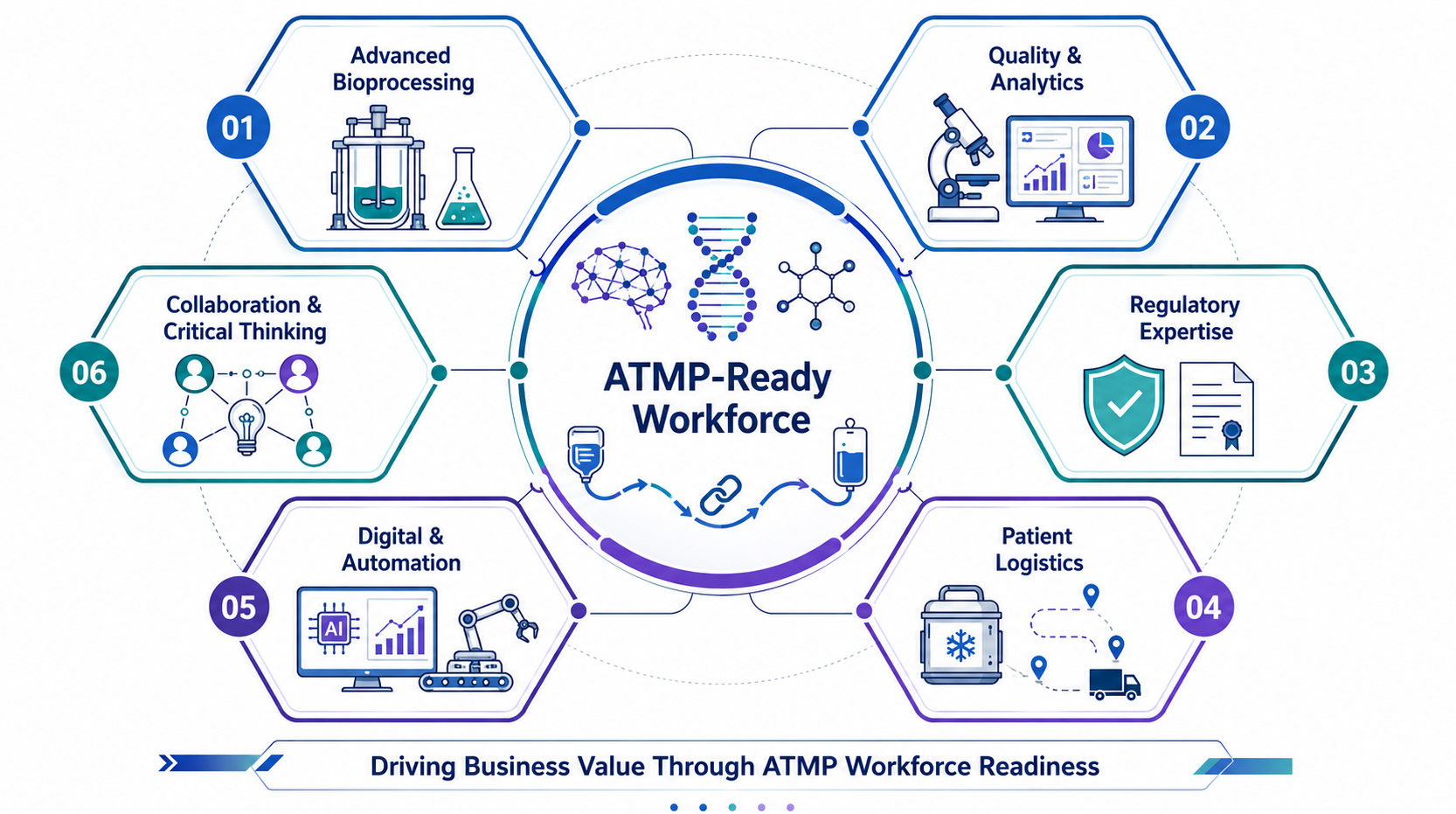
Research and industry surveys converge on several critical capability clusters that define a genuinely ATMP-capable workforce.
Advanced bioprocessing and cell culture. ATMP manufacturing requires deep, hands-on expertise in cell biology, aseptic processing, contamination control, and specialized bioprocessing systems. Proficiency must extend from cell expansion and harvest through purification, cryopreservation, and working with highly variable patient-derived materials. Surveys consistently identify gaps in aseptic technique, automation, digital skills, and bioinformatics, despite their foundational importance to reliable manufacturing.
Complex quality control and analytics. Quality control for living products differs fundamentally from that for small molecules. Assessing viability, potency, identity, and purity often requires bespoke assays and real-time decision-making during manufacturing. Skills shortages are particularly acute in analytical methods, assay development, flow cytometry, and contamination control, with quality roles among the hardest to fill as products move toward commercialization.
ATMP-specific regulatory expertise. Regulatory professionals must understand the unique requirements governing patient-specific therapies, including documentation, traceability, donor screening, and long-term monitoring. While specialized training programs are emerging, demand continues to outstrip supply significantly.
Patient logistics and cross-site coordination. Coordinating the vein-to-vein journey requires expertise in cryogenic logistics, scheduling, real-time problem-solving, and cross-functional communication. Ensuring the right patient receives the right treatment at the right time depends as much on coordination and process discipline as on the underlying science.
Digital, automation, and data skills. As ATMP facilities adopt closed systems, automation, and digital process controls, workers must be comfortable with electronic batch records, real-time monitoring, data integrity, and cybersecurity in regulated environments. Bioinformatics and digital fluency remain among the most frequently cited capability gaps across the sector.
THE SOFT SKILLS GAP
Perhaps most strikingly, soft skills often score as larger gaps than technical knowledge. ATMP manufacturing is collaborative, high-stakes, and fast-moving. Teams must make decisions with incomplete information, communicate across disciplines, and adapt quickly to change. Critical thinking, resilience, and cross-functional collaboration are not optional extras. They are core operational competencies.
Rethinking Training for ATMPs
Unlock the Full Research
Create a free account or sign in to access the complete methodology, deep-dive analysis, and key implementation frameworks.
Don't have an account? It's free to join.
Organization Learning Labs
Research & Insights Division


Comments