Additive Manufacturing Talent: Scaling Production Beyond Pilots

3D printing is moving from prototyping to production. Learn the capability stack and learning systems manufacturers need to scale additive manufacturing.
From Casting to Printing: Building Talent and Learning Systems for Additive Manufacturing and Advanced Materials
Additive manufacturing is crossing the production-volume threshold. The bottleneck standing between pilot and scale is talent, not technology
1. Introduction: The Shift From Subtractive to Additive
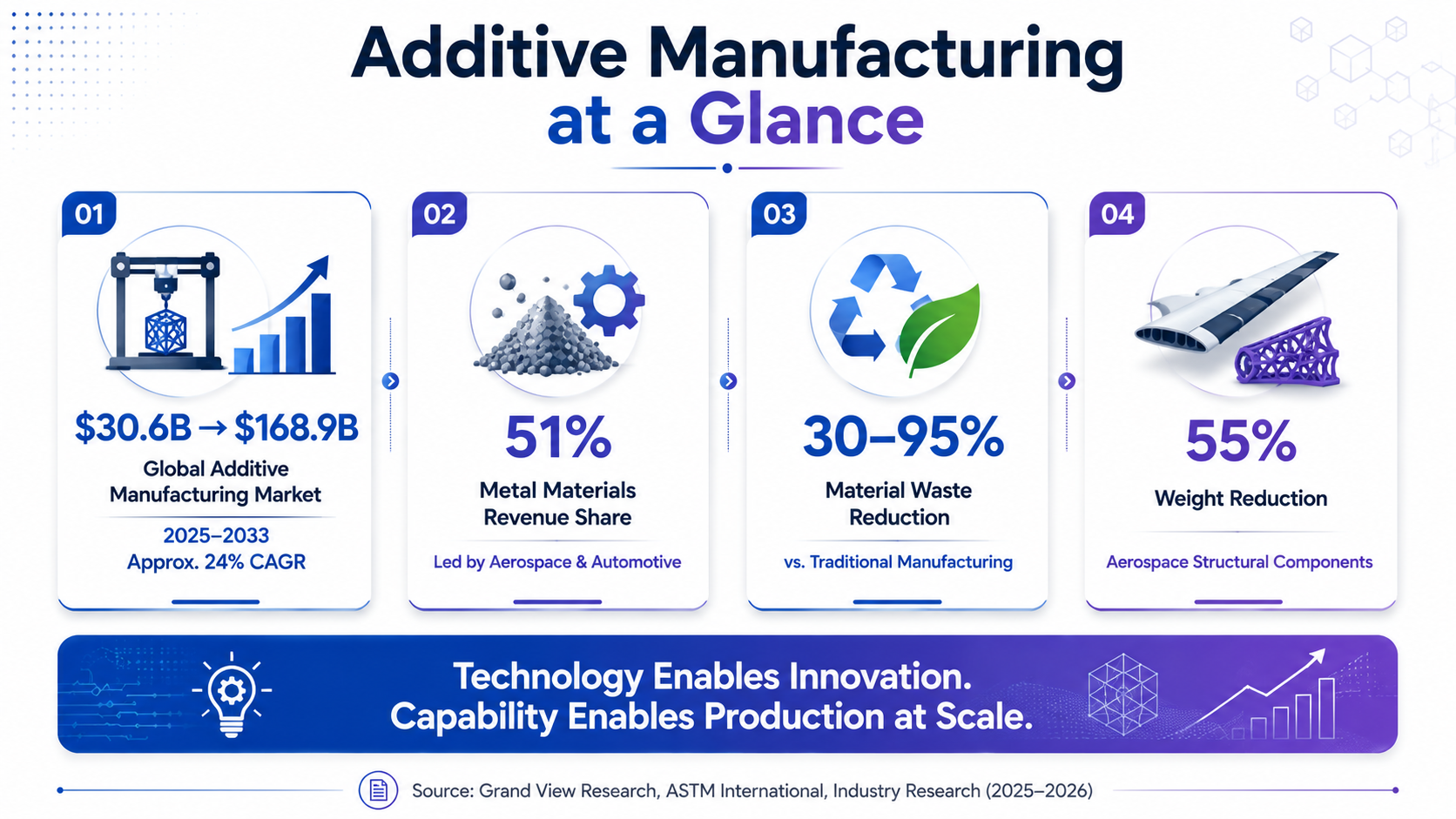
Additive manufacturing capability has quietly crossed a threshold that most conversations about 3D printing have not caught up with. For most of its history, additive manufacturing was a prototyping and tooling technology, valued for speed rather than treated as a genuine production method. That has changed. The global additive manufacturing market, valued at roughly 30.6 billion dollars in 2025, is now built substantially around end-use part production rather than prototyping, and 2025 spending data shows end-use part production has overtaken both prototyping and tooling as the leading use case for the first time. Aerospace certification of structural components, medical device personalization, and automotive lightweighting programs are the forces pulling additive manufacturing from the innovation lab onto the production floor.
The market numbers reflect this shift. Depending on the analyst and the scope counted, the additive manufacturing market is projected to grow from roughly 25 to 30 billion dollars in 2025 to somewhere between 140 and 170 billion dollars by the early-to-mid 2030s, a compound annual growth rate consistently in the 18 to 24 percent range across multiple research houses. Real production deployments back this up: Daimler Truck AG now produces close to 40,000 bus spare parts on demand through a 3D printing partnership, cutting delivery times by up to 75 percent, and Boeing uses 3D-printed titanium structural components across multiple aircraft programs.
Yet the gap between market enthusiasm and organizational readiness remains wide. A recurring finding across manufacturing surveys is that final-product quality consistency and post-processing requirements, not the printers themselves, are the reasons manufacturers cite for choosing other production methods when additive manufacturing would otherwise make sense. That gap is a talent and process-maturity gap, not a technology gap, and it is the subject of this article: what capability stack, talent architecture and learning system does a manufacturer actually need to move additive manufacturing from pilot to scale.
Post-processing requirements and final-product quality consistency, not printer capability, are the two most cited reasons manufacturers choose other production methods over additive manufacturing. The bottleneck is process maturity, not hardware. — Protolabs Network, 3D Printing Trend Report, synthesized industry survey findings |
2. The Capability Stack for Additive and Advanced Materials
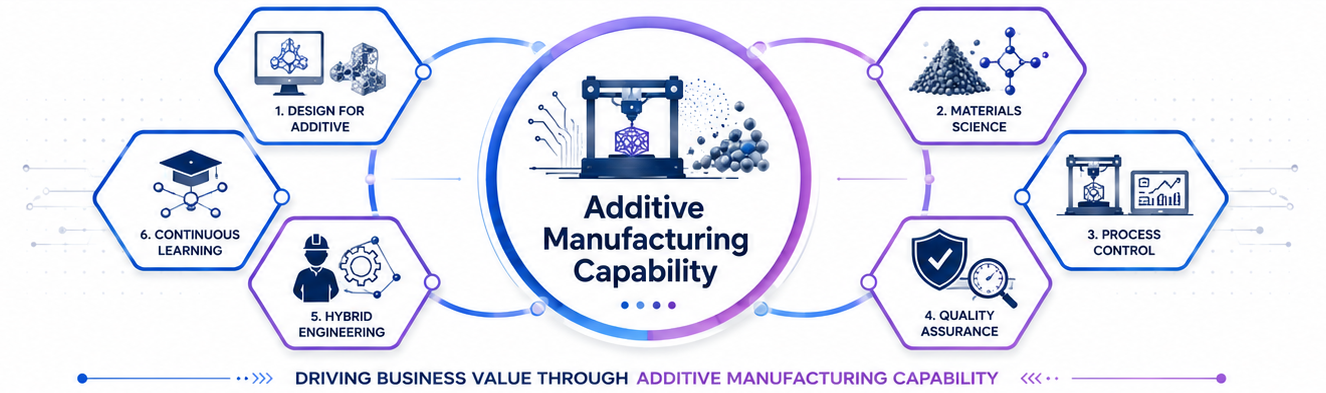
Additive manufacturing capability rests on four interlocking disciplines that, in traditional manufacturing, are usually the responsibility of separate departments that rarely need to collaborate this closely. Design for additive manufacturing requires engineers to think in terms of generative design, topology optimization and lattice structures that would be impossible or prohibitively expensive to machine conventionally, which is a genuinely different design paradigm rather than an extension of existing CAD skill. Materials science, the second discipline, determines whether a given metal powder, polymer filament or ceramic feedstock will behave predictably under the specific thermal and mechanical conditions of a given printing process, and unlike traditional material selection from a known catalog, additive materials science frequently involves characterizing new material behavior as printing parameters change.
Process control, the third discipline, governs the parameters, laser power, layer thickness, scan speed, chamber atmosphere, that determine whether a printed part meets specification, and small parameter drift can produce defects invisible until a part fails under load. Quality assurance for printed parts, the fourth discipline, requires inspection and certification approaches substantially different from traditional manufacturing quality control, since internal defects in additively manufactured parts are not always detectable by the surface inspection methods that work for cast or machined components. Aerospace and medical device manufacturers, where certification stakes are highest, have been the furthest along in building rigorous quality frameworks for exactly this reason.
Capability Layer | Core Discipline | Where Talent Is Scarcest |
Design for additive | Generative design, topology optimization, lattice structures | Engineers with both CAD fluency and additive-specific design intuition |
Materials science | Powder, filament and resin characterization under process conditions | Metallurgists who understand powder bed fusion process physics |
Process control | Parameter management across laser power, layer thickness, scan strategy | Hybrid process engineers bridging materials and machine operation |
Quality assurance | Internal defect detection, certification, non-destructive testing | Quality engineers trained on additive-specific inspection methods |
3. Talent Archetypes for Additive and Advanced Materials
Three talent archetypes recur across manufacturers that have successfully scaled additive manufacturing beyond a pilot cell. Additive design engineers combine mechanical engineering fundamentals with fluency in generative design and simulation software, and crucially, an intuition for which geometries a given printing process can actually produce reliably, a form of tacit knowledge that is difficult to teach from a manual and is usually built through supervised iteration on real parts. Materials innovators, often trained in metallurgy, polymer science or ceramics engineering, work at the boundary between materials research and production, characterizing new feedstocks and troubleshooting the material-related defects that account for a large share of failed print jobs.
Unlock the Full Research
Create a free account or sign in to access the complete methodology, deep-dive analysis, and key implementation frameworks.
Don't have an account? It's free to join.
Organization Learning Labs
Research & Insights Division


Comments