A Systematic Framework for IT Services Capability Development

A seven-step, evidence-based sequence for building the six organizational capabilities that separate future-ready IT services organizations, mirrored by one company’s real multi-year AI build-out.
A Systematic Framework for IT Services Capability Development
Eight drivers, eight structural barriers, six organizational capabilities, and one finding: capability outperforms strategy. This is the sequence that turns all of it into a result, mirrored by the multi-year path one real organization has already walked.
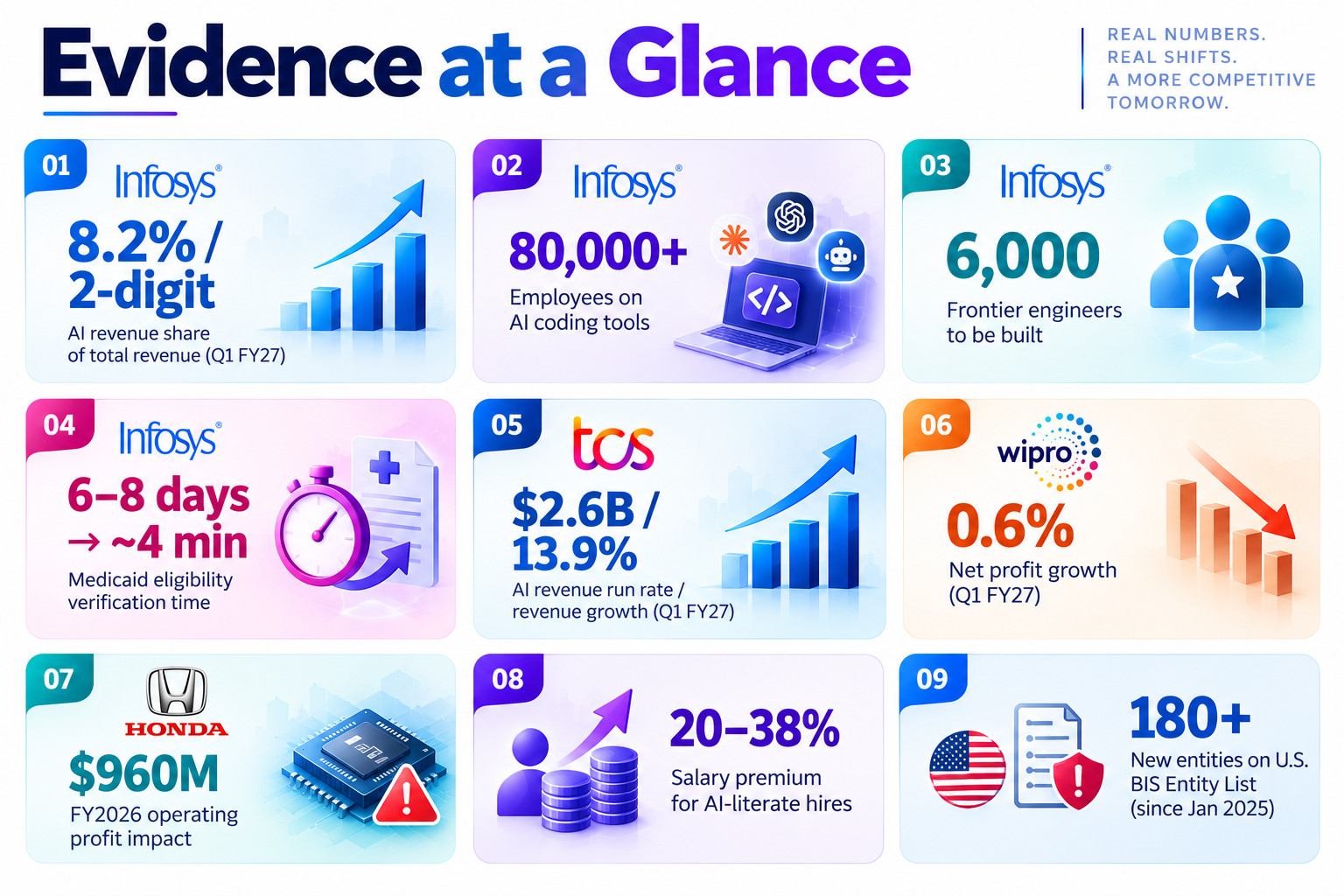
EVIDENCE AT A GLANCE
8.2% / 2-digit Infosys’s AI revenue as a share of total revenue in FY27 Q1, growing at a strong double-digit rate sequentially over multiple quarters Source: Infosys Form 6-K, Q1 FY2027 | 80,000+ Infosys employees now working on AI coding tools such as Claude Code or Codex Source: Infosys Form 6-K, Q1 FY2027 | 6,000 Frontier engineers Infosys plans to build over the next few years, a disclosed forward workforce target Source: Infosys Form 6-K, Q1 FY2027 |
6–8 days → ~4 min Reduction in Medicaid eligibility verification time for a healthcare client after Infosys deployed AI agents to the process Source: Infosys Form 6-K, Q1 FY2027 | $2.6B / 13.9% TCS’s Q1 FY27 annualised AI revenue run rate and reported revenue growth Source: TCS Q1 FY27 results, reported August 2026 | 0.6% Wipro’s Q1 FY27 net profit growth, as AI investment costs outpaced returns in the same quarter Source: Wipro Q1 FY27 results, reported August 2026 |
$960M Honda’s estimated FY2026 operating profit impact from semiconductor shortages tied to the Nexperia export dispute Source: Honda FY2026 financial guidance | 20–38% Salary premium Indian technology employers are paying for AI-literate hires Source: 1Finance data, reported via Business Standard, July 2026 | 180+ New entities added to the U.S. Bureau of Industry and Security Entity List since January 2025 Source: U.S. BIS Entity List, tracked in 2026 supply chain analysis |
From Diagnosis to Discipline
IT services and consulting organizations face six organizational capabilities, spanning engineering, decision-making, innovation, collaboration, strategy, and leadership, that define what future-ready looks like. Structural factors inside most organizations, incentive misalignment, fragmented decision rights, quarterly reporting cycles that reward margin protection over multi-year investment, make recognizing those capabilities a different thing from building them. And capability, not stated strategy, is what determines whether an organization’s investment converts into a result, evidenced directly by the gap between TCS’s $2.6 billion AI revenue run rate and Wipro’s flat profit growth from comparable spending in the same quarter.
None of that is a plan on its own. This article is. It turns the diagnosis into a sequence, seven steps, mirrored throughout by a real, multi-year, publicly disclosed capability build-out rather than proposed in the abstract.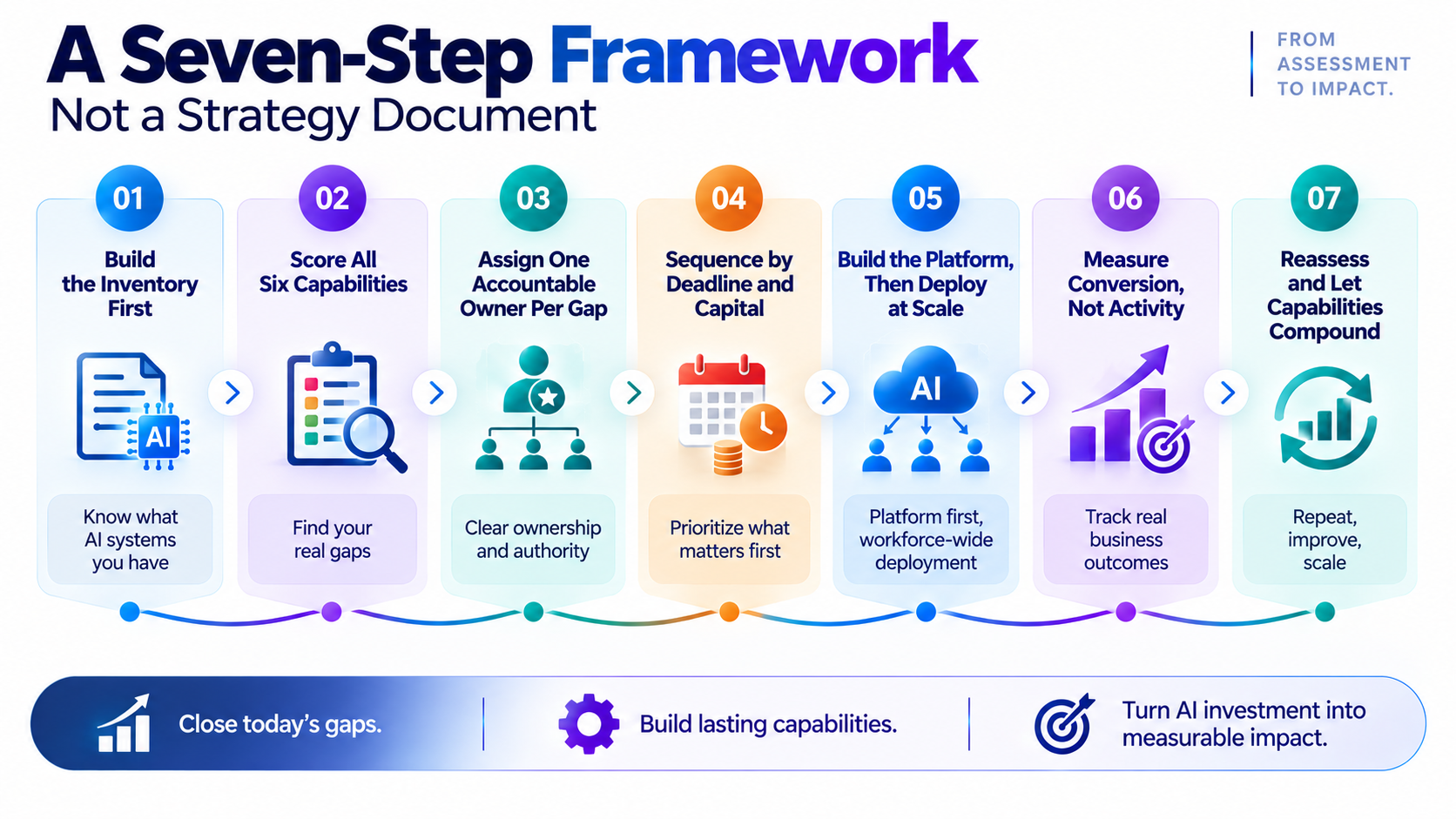
A Seven-Step Framework, Not a Strategy Document
Each step closes a specific gap described above. None is optional, and the order is deliberate: reversing it, building the platform before the inventory exists, for instance, is how organizations end up with a Wipro-shaped outcome, real AI investment that does not convert into revenue or margin.
1. Build the Inventory Before Anything Else
Every structural factor that blocks capability-building, from decision-rights fragmentation to regulatory exposure, traces back to the same starting deficiency: most organizations cannot say with precision how many AI systems they operate, in what form, for which clients. The EU AI Act’s August 2026 high-risk obligations require a complete AI system inventory before conformity assessments or database registration can even begin. This is not a compliance nicety; it is the first fact an organization needs before it can honestly score itself against any of the six capabilities that follow.
2. Score All Six Capabilities Against Reality
Once the inventory exists, an organization can honestly complete the assessment that follows: what the future requires, where the organization stands today, the specific gap between the two, and what readiness actually requires, run across all six organizational capabilities, each scored on what the organization can demonstrate, not what a strategy document claims.
The Complete Capability Scorecard
Capability | Industry “Is” Today | Target “To-Be” State | What Readiness Requires |
AI-Augmented, Industry-Contextualized Technology & Engineering | AI revenue remains a single-digit share of total revenue even at capability leaders; Infosys reports 8.2% | AI-augmented delivery as the default engineering discipline, tracked with revenue-grade metrics, fluent in client industry context | AI-augmented engineers and industry-vertical architects as standing roles; delivery pipelines built around AI tooling by design; architecture review governance; a platform like Infosys’s Topaz Fabric maintained against a current systems inventory |
Enterprise Problem-Solving & Decision Intelligence | Most major commitments still rely on single-approver sign-off with no structured alternative-evaluation | Documented, evidence-based decision processes standard for major commitments | Enterprise architects and decision-trained analysts as named roles; documented alternative-evaluation processes; a standing forum with authority to require evidence before major capital commitments; decision-support and scenario-modeling technology |
Continuous Innovation & Adaptive Enterprise Learning | Innovation investment is typically the first line item cut under quarterly margin pressure | A standing, funded innovation pipeline that survives cost-cutting cycles | Innovation and reskilling program owners as named roles; a standing technology-sensing cycle with funded pilot-to-scale pathways; governance that ring-fences the innovation budget; sandboxed experimentation technology and a tracked skills inventory |
Integrated, Ecosystem-Enabled & Client-Centric Collaboration | GCCs and hyperscaler partners treated almost entirely as competitive threats, with no coordination model | Joint planning and shared outcome metrics with client GCCs and ecosystem partners | Partner-orchestration leads and client executives with cross-functional authority; joint planning cadences and shared metrics as standing process; governance treating a client’s GCC as a coordination partner; shared collaboration platforms accessible to partners and clients |
Business-Led Technology Strategy & Outcome-Oriented Consulting | Still substantially priced by time and materials | Meaningful revenue share converted to outcome-based terms, as TCS’s $2.6B AI revenue run rate shows is possible | Technology-to-business translators and value-realization owners as distinct roles; outcome-based contracting as a standing commercial motion; governance reporting outcome-priced revenue share at the same scrutiny as headline revenue; value-tracking technology tied to the contract |
Responsible, Adaptive & Transformation-Oriented Leadership | Accountability fragmented across business units; initiatives stall with no one able to unblock them | One accountable owner per initiative with real budget authority, Amazon-style, plus a succession-planned leadership pipeline | Single-threaded capability owners and a named technology governance owner as standing roles; succession planning as a standing discipline; governance reviews with real veto authority; audit-trail technology tracing decisions to the accountable leader |
3. Assign One Accountable Owner Per Gap
Amazon’s single-threaded leadership model, documented by former Amazon executives Colin Bryar and Bill Carr in Working Backwards, assigns one accountable owner per initiative specifically to eliminate the cross-team dependencies that stall decisions. Applied to the scorecard above, each of the six rows needs exactly one named owner with real authority to move budget and headcount, not a committee spanning business units that individually hold partial jurisdiction and collectively hold none. This step directly closes the decision-rights fragmentation that stalls so many capability initiatives at the business-unit boundary.
4. Sequence by Deadline and Capital, Not by Preference
Not all six gaps close on the same clock, and a systematic framework sequences by real constraint, not internal preference. Responsible, transformation-oriented leadership carries the nearest hard external deadline: the EU AI Act’s August 2026 obligations require a named governance owner and an audit trail in place before the deadline, not after. Business-led, outcome-oriented strategy and responsible leadership governance require no new capital and can start immediately, which is why they belong first regardless of urgency elsewhere. Enterprise problem-solving and decision-intelligence readiness sits partly on a schedule set by outside events entirely, as Honda’s roughly $960 million FY2026 impact from the Nexperia dispute shows; an organization sequences around that unpredictability by building structured risk-evaluation capacity before the next disruption, not after.
5. Build the Platform, Then Deploy It at Workforce Scale
Infosys’s own multi-year record shows what this step looks like in practice. It launched its Topaz platform in 2023, expanded it into the more advanced Topaz Fabric layer in November 2025, and by its FY2027 first quarter reported AI revenue at 8.2% of total revenue, growing at a strong double-digit rate sequentially over multiple quarters, with more than 80,000 employees now working on AI coding tools. The sequence is the point: platform first, then workforce-wide deployment, not the reverse. An organization that tries to deploy AI tooling at scale before the underlying platform and governance exist is building on top of the same inventory gap Step 1 exists to close.
6. Measure Conversion, Not Activity
The metric that matters is not investment made; it is investment converted. Infosys can point to a concrete case: AI agents built to automate Medicaid eligibility verification for a healthcare client cut processing time from six to eight days down to approximately four minutes, a disclosed, measurable outcome, not a claimed one. TCS’s $2.6 billion annualised AI revenue run rate is the same kind of evidence at the enterprise level. Wipro’s flat Q1 FY27 profit growth despite comparable AI investment is the same test, failed. An organization applying this framework tracks the second kind of number, not the first.
7. Reassess and Let the Capabilities Compound
The scorecard is not a one-time exercise. Infosys’s own disclosed plan to build a team of 6,000 frontier engineers over the next few years is itself evidence that the organizations furthest along treat capability-building as a standing, multi-year commitment, not a project with an end date. Each of the six capabilities reinforces the others once several are in place together, the same pattern visible across Honda, TCS, and Infosys above. The framework closes by returning to Step 1, with a more current inventory, and running the scorecard again.
Why the Sequence Only Works as a Whole
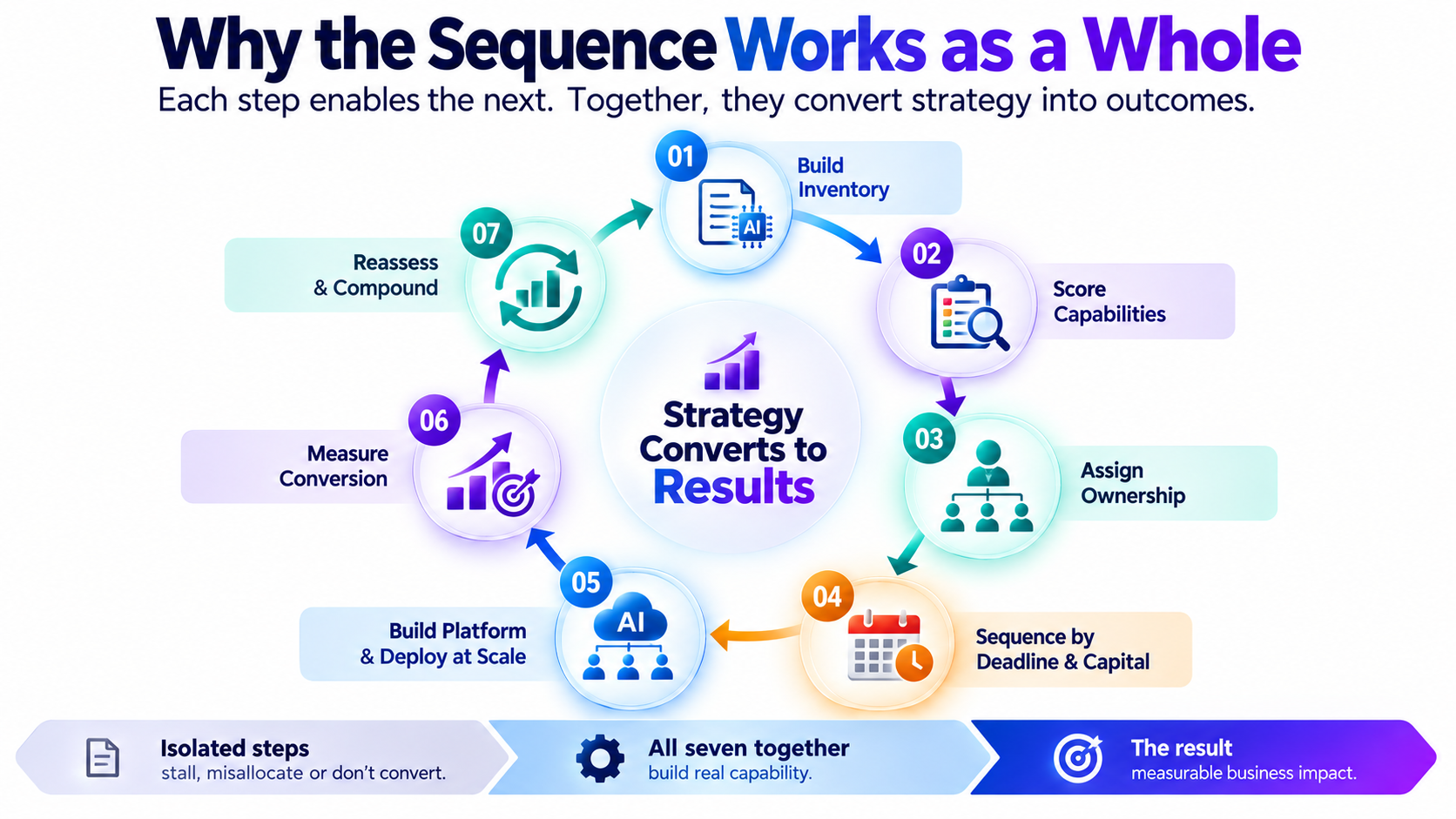
None of the seven steps above works in isolation. A capability scorecard without single-threaded ownership stalls at the business-unit boundary, diagnosed but never owned. Single-threaded ownership without a sequenced plan spends its authority on the wrong gap first. A sequenced plan without conversion metrics produces exactly the outcome Wipro’s Q1 FY27 result shows: real investment, no real result. Knowing what the future requires, understanding why organizations struggle to build it, defining the specific capabilities that matter, and recognizing that capability outperforms stated strategy all matter, but none of it is a plan until it runs through the sequence above.
The organizations that close this loop, inventory, score, own, sequence, build, measure, and reassess, are the ones future-ready enough to compete on the forces reshaping IT services and consulting. The rest will keep announcing strategies into a market that has already stopped rewarding them.
Executive FAQs
Does running this framework require bringing in outside consultants?
No. Every mechanism in it, the inventory, the single-threaded ownership model, the platform-then-workforce sequencing, is something an organization builds and owns internally. Amazon’s single-threaded model and Infosys’s multi-year Topaz build-out are both internally run capabilities, not purchased engagements.
What is the actual first deliverable, on day one?
The inventory, concretely: a complete, current list of every AI system the organization operates, not a strategy deck or a board presentation. Every later step in this framework depends on that list existing and being accurate.
How long does one full cycle of this framework take?
Steps 1 and 2, the inventory and the initial scorecard, can happen in weeks. Steps 5 through 7, building the platform, deploying it at scale, and generating measurable conversion, take years; Infosys’s own path from its 2023 Topaz launch to an 8.2% AI revenue share in FY27 spans roughly four years. A framework promising faster than that is not describing capability.
Where do organizations most commonly get stuck?
Step 3 and Step 6. Fragmented accountability means a gap gets diagnosed but never owned, and without a named owner with real budget authority, nothing after Step 2 actually happens. Where ownership does exist, the next most common failure is Step 6: continuing to report investment made rather than tracking what it converted into, the exact pattern behind Wipro’s flat Q1 FY27 profit growth.
Could a smaller organization without Infosys’s scale actually run this?
Yes. The steps scale down; Infosys and TCS are evidence that the sequence works, not a prerequisite for using it. A smaller organization’s inventory is shorter, its scorecard covers fewer business units, and its single-threaded owners cover more ground each, but the same seven steps in the same order apply regardless of size.
References
1. Infosys Ltd, Form 20-F, fiscal year 2025, U.S. Securities and Exchange Commission filing.
2. Infosys Ltd, Form 20-F, fiscal year 2026, U.S. Securities and Exchange Commission filing.
3. Infosys Ltd, Form 6-K, Q1 fiscal year 2027 results (April–June 2026), U.S. Securities and Exchange Commission filing.
4. Colin Bryar and Bill Carr, Working Backwards: Insights, Stories, and Secrets from Inside Amazon, St. Martin’s Press, 2021.
5. Reporting on Tata Consultancy Services, Infosys, Wipro, and HCL Technologies Q1 FY27 results, Indian financial media, August 2026.
6. Nasscom, "Technology Sector in India: Strategic Review 2026," February 2026.
7. Reuters, reporting on Tata Consultancy Services workforce restructuring, July 2026.
8. Honda Motor Co., FY2026 financial guidance on semiconductor-related operating profit impact, cited in 2026 supply chain analysis.
9. European Union, Artificial Intelligence Act, high-risk obligation provisions and enforcement timeline (Articles 9–17, 26).
10. U.S. Bureau of Industry and Security, Entity List additions, tracked in 2026 semiconductor supply chain analysis.
11. 1Finance salary premium data for AI-literate technology roles, reported via Business Standard, July 2026.
Organization Learning Labs
Research & Insights Division


