A Systematic, Empirical Framework for Capability Development in Retail Banking

Eight drivers, eight structural barriers, six organizational capabilities, and one finding: capability outperforms strategy. This is the sequence that turns all of it into a result, mirrored by the multi-year path one real bank has already walked.
A Systematic, Empirical Framework for Capability Development in Retail Banking
Eight drivers, eight structural barriers, six organizational capabilities, and one finding: capability outperforms strategy. This is the sequence that turns all of it into a result, mirrored by the multi-year path one real bank has already walked.
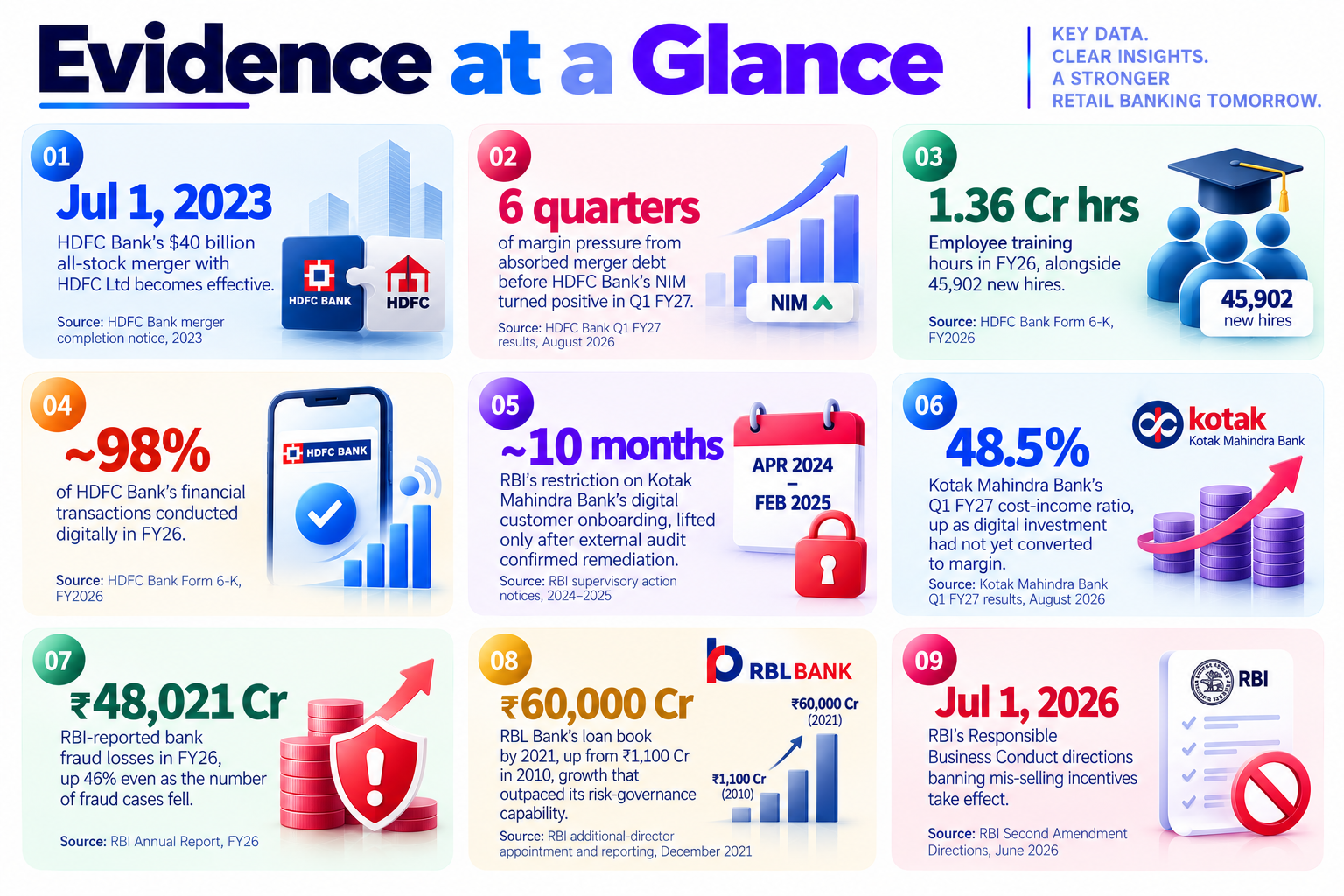
EVIDENCE AT A GLANCE
Jul 1, 2023 Effective date of HDFC Bank’s $40 billion all-stock merger with HDFC Ltd, the starting point of the multi-year capability path this framework mirrors Source: HDFC Bank merger completion notice, 2023 | 6 quarters Consecutive quarters of margin pressure from absorbed merger debt before HDFC Bank’s net interest margin turned positive in Q1 FY27 Source: HDFC Bank Q1 FY27 results, August 2026 | 1.36 Cr hrs Employee training hours HDFC Bank disclosed for FY26, alongside 45,902 new hires Source: HDFC Bank Form 6-K, FY2026 |
~98% Share of HDFC Bank’s financial transactions conducted digitally in FY26 Source: HDFC Bank Form 6-K, FY2026 | ~10 months Length of RBI’s restriction on Kotak Mahindra Bank’s digital customer onboarding, lifted only after external audit confirmed remediation Source: RBI supervisory action notices, 2024–2025 | 48.5% Kotak Mahindra Bank’s Q1 FY27 cost-income ratio, up as digital investment had not yet converted to margin Source: Kotak Mahindra Bank Q1 FY27 results, August 2026 |
₹48,021 Cr RBI-reported bank fraud losses in FY26, up 46% even as the number of fraud cases fell Source: RBI Annual Report, FY26 | ₹60,000 Cr RBL Bank's loan book by 2021, up from ₹1,100 Cr in 2010, growth that outpaced its risk-governance capability Source: RBI additional-director appointment and reporting, December 2021 | Jul 1, 2026 RBI’s Responsible Business Conduct directions banning mis-selling incentives take effect Source: RBI Second Amendment Directions, June 2026 |
From Diagnosis to Discipline
Retail banks face six organizational capabilities, spanning digital and AI-enabled banking, risk intelligence, innovation, ecosystem collaboration, outcome-oriented strategy, and governance leadership, that define what future-ready looks like. Structural factors inside most banks, incentive structures that reward commission over suitability, fragmented decision rights, quarterly reporting cycles that reward margin protection over multi-year investment, make recognizing those capabilities a different thing from building them. And capability, not stated strategy, is what determines whether a bank’s investment converts into a result, evidenced directly by the gap between HDFC Bank’s net interest margin turning positive and Kotak Mahindra Bank’s cost-income ratio climbing on comparable digital spending in the same quarter.
None of that is a plan on its own. This article is. It turns the diagnosis into a sequence, seven steps, mirrored throughout by a real, multi-year, publicly disclosed capability path rather than proposed in the abstract.
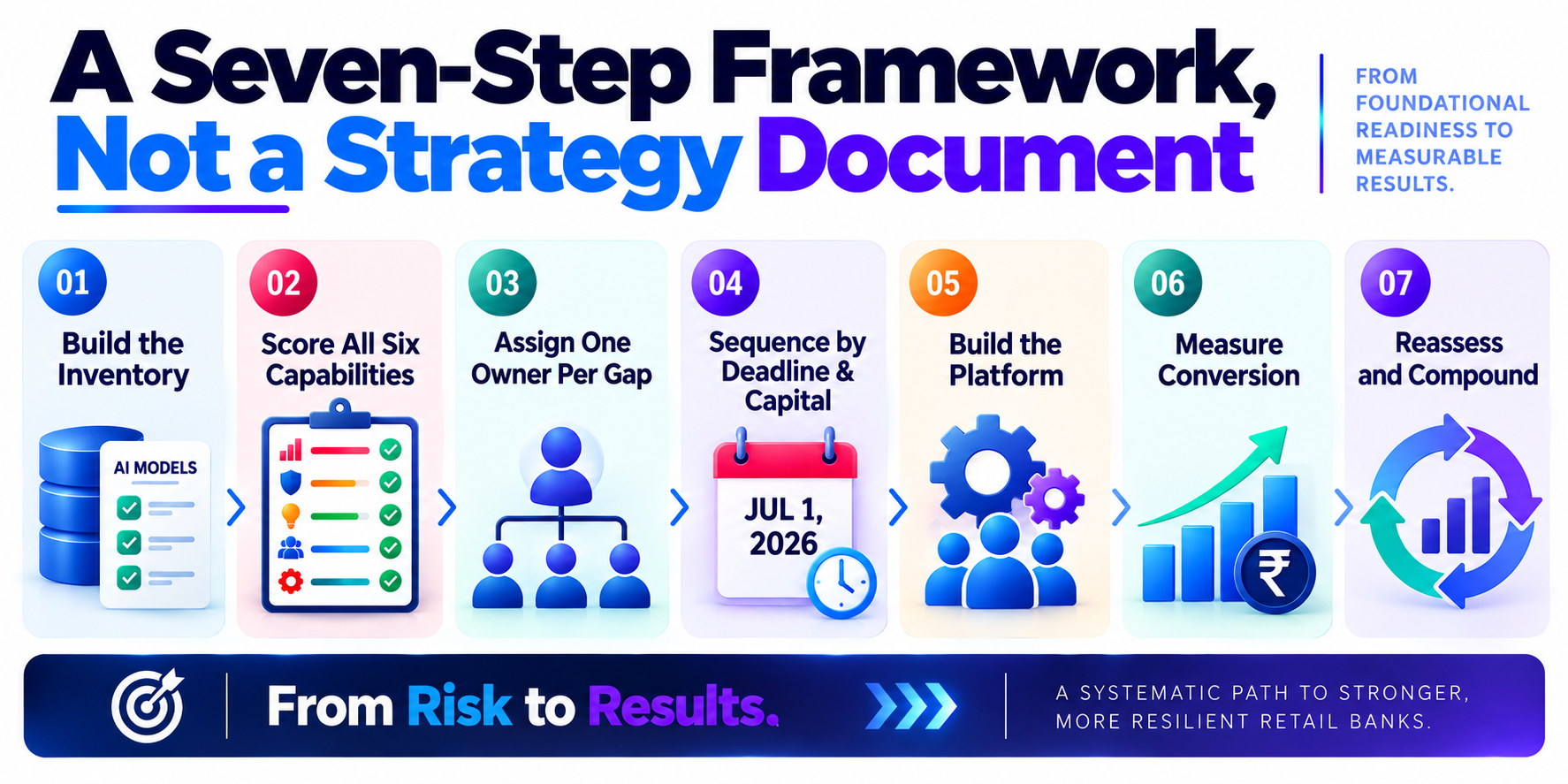
A Seven-Step Framework, Not a Strategy Document
Each step closes a specific gap described above. None is optional, and the order is deliberate: reversing it, building digital capability before the risk-governance foundation exists, is how banks end up with the exact outcome Kotak Mahindra Bank absorbed in April 2024, a real, ten-month business restriction.
1. Build the Inventory Before Anything Else
Every structural factor that blocks capability-building, from decision-rights fragmentation to regulatory exposure, traces back to the same starting deficiency: most banks cannot say with precision how many AI and scoring models they operate, in what form, for which customers. RBI’s 2026 regulatory baseline requires a complete model inventory before validation, documentation, or governance can even begin. This is not a compliance nicety; it is the first fact a bank needs before it can honestly score itself against any of the six capabilities that follow.
2. Score All Six Capabilities Against Reality
Once the inventory exists, a bank can honestly complete the assessment that follows: what the future requires, where the bank stands today, the specific gap between the two, and what readiness actually requires, run across all six organizational capabilities, each scored on what the bank can demonstrate, not what a strategy document claims.
The Complete Capability Scorecard
Capability | Industry “Is” Today | Target “To-Be” State | What Readiness Requires |
Digital, AI-Enabled & Customer-Centric Banking | Digital treated as a separate initiative from branch and workforce planning at most banks | Digital and branch journeys designed jointly, with workforce training tracked alongside technology rollout, as HDFC Bank’s 98% digital transaction share and 1.36 crore training hours show | Digital-journey owners and AI-personalization leads as standing roles; delivery pipelines built around AI tooling by design; architecture governance against RBI’s 2026 model inventory baseline; platforms that make branches advisory centers, not transaction counters |
Enterprise Risk Intelligence & Responsible Decision-Making | Governance gaps go unaddressed across multiple examination cycles, as they did at Kotak Mahindra Bank for 2022 and 2023 before restriction followed | IT and model governance continuously audited and remediated ahead of regulatory review, not after | Credit risk officers, fraud-detection leads, and named model-validation owners as standing roles; documented alternative-evaluation before major credit decisions; RBI’s mandated model inventory with validation evidence; behavioral, network-based fraud detection, not threshold rules alone |
Continuous Innovation & Adaptive Banking | Innovation confined to press-release pilots with no path through a governed testing process | Structured engagement with real testing pathways like RBI’s Regulatory Sandbox as a standing discipline, not a one-time exercise | Innovation and experimentation leads as standing roles; a standing technology-sensing cycle with funded pilot-to-scale pathways; governance that ring-fences innovation investment from quarterly cost-cutting; sandboxed testing environments |
Integrated, Ecosystem-Enabled & Customer-Responsive Collaboration | Fintech and data-sharing partners treated purely as competitive threats, with no coordination model | Direct lending and card partnerships with dominant fintech platforms, like ICICI Bank's Credit Line on UPI with PhonePe or Axis Bank's co-branded Google Pay Flex card, integrated into core lending and advisory workflows | Partner-orchestration leads and relationship managers with cross-functional authority; joint planning cadences with fintech and NPCI-governed partners; governance treating ecosystem partners as coordination partners; shared data and journey-management platforms |
Business-Led Banking Strategy & Outcome-Oriented Service | Digital spend rising without a governed link to margin, as Kotak Mahindra Bank’s 48.5% cost-income ratio shows | Margin conversion from digital and product investment tracked and governed as a standing discipline, as HDFC Bank’s margin turn after six quarters of pressure shows is achievable | Segment and product strategy owners, plus commercial and value-realization leads, as distinct roles; standing value-realization tracking; governance reviewing margin conversion at the same scrutiny as headline growth; performance-tracking systems tied to specific product decisions |
Responsible, Adaptive & Trust-Centred Banking Leadership | Accountability diffused across committees, with no single owner for remediation | One named leader accountable for governance remediation, validated by external audit, the path Kotak Mahindra Bank followed to have its restrictions lifted | A named grievance and governance accountability owner, succession-planned leadership pipeline, and a designated technology governance owner; governance review with real veto authority; audit-trail systems tracing decisions to the accountable leader |
3. Assign One Accountable Owner Per Gap
Amazon’s single-threaded leadership model, documented by former Amazon executives Colin Bryar and Bill Carr in Working Backwards, assigns one accountable owner per initiative specifically to eliminate the cross-team dependencies that stall decisions. Applied to the scorecard above, each of the six rows needs exactly one named owner with real authority to move budget and headcount, not a committee spanning risk, compliance, and business units that individually hold partial jurisdiction and collectively hold none. This step directly closes the decision-rights fragmentation that let Kotak Mahindra Bank’s IT governance gap go unaddressed across two full examination cycles before RBI intervened. RBL Bank shows the same fragmentation from a different angle: the bank scaled its loan book from ₹1,100 crore to ₹60,000 crore between 2010 and 2021, with credit cards reaching roughly 20% of the book, the industry's highest share, without risk-appraisal capability scaling alongside it; when no internal owner closed that gap, RBI closed it externally, appointing an additional director to the board in December 2021 and shortening the incumbent CEO's final term.
4. Sequence by Deadline and Capital, Not by Preference
Not all six gaps close on the same clock, and a systematic framework sequences by real constraint, not internal preference. Responsible, trust-centred leadership carries the nearest hard external deadline: RBI’s Responsible Business Conduct directions banning mis-selling incentives take effect July 1, 2026, and the model inventory baseline is already in force. Business-led, outcome-oriented strategy and responsible leadership governance require no new capital and can start immediately, which is why they belong first regardless of urgency elsewhere. Enterprise risk intelligence sits partly on a schedule set by outside events entirely, as the roughly ten-month gap between Kotak Mahindra Bank’s restriction and its lifting shows; a bank sequences around that unpredictability by building structured governance capacity before the next examination cycle, not after. RBL Bank is the clearest evidence of what the wrong order costs: it built scale in unsecured retail lending for more than a decade before its risk-appraisal capability caught up, and correcting the gap cost the bank its CEO's final term and a regulator's own director on its board. Business-led growth without enterprise risk intelligence running in parallel is not a sequencing risk in theory; it is what RBL Bank actually lived through.
5. Build the Platform, Then Deploy It at Workforce Scale
HDFC Bank’s own multi-year record shows what this step looks like in practice. Its $40 billion merger with HDFC Ltd took effect July 1, 2023, absorbing wholesale debt that pressured margins for six consecutive quarters while the bank continued investing in digital and workforce capability throughout, 1.36 crore training hours and 45,902 new hires disclosed for FY26 alone, until its net interest margin turned positive in Q1 FY27. The sequence is the point: structural integration and workforce investment first, margin conversion after, not the reverse. A bank that expects digital investment to convert to margin before the underlying workforce and governance capability exists is building on top of the same inventory gap Step 1 exists to close.
6. Measure Conversion, Not Activity
The metric that matters is not investment made; it is investment converted. HDFC Bank’s net interest margin turning positive after six quarters of pressure is a disclosed, measurable outcome, not a claimed one. Kotak Mahindra Bank’s restrictions being lifted only after a comprehensive external audit confirmed real remediation, not a self-reported fix, is the same kind of evidence in a regulatory register. Kotak Mahindra Bank’s rising Q1 FY27 cost-income ratio despite comparable digital investment is the same test, failed. A bank applying this framework tracks the audited, converted outcome, not the announcement.
7. Reassess and Let the Capabilities Compound
The scorecard is not a one-time exercise. HDFC Bank’s continued FY26 investment in training and hiring, three years after its merger took effect, is itself evidence that the banks furthest along treat capability-building as a standing, multi-year commitment, not a project with an end date. Each of the six capabilities reinforces the others once several are in place together, the same pattern visible across HDFC Bank, Kotak Mahindra Bank, and RBI’s own industry-wide fraud data above. The framework closes by returning to Step 1, with a more current inventory, and running the scorecard again.
Why the Sequence Only Works as a Whole
None of the seven steps above works in isolation. A capability scorecard without single-threaded ownership stalls at the business-unit boundary, diagnosed but never owned. Single-threaded ownership without a sequenced plan spends its authority on the wrong gap first. A sequenced plan without conversion metrics produces exactly the outcome Kotak Mahindra Bank’s Q1 FY27 result shows: real investment, no real margin. Knowing what the future requires, understanding why banks struggle to build it, defining the specific capabilities that matter, and recognizing that capability outperforms stated strategy all matter, but none of it is a plan until it runs through the sequence above. Growth capability built without risk intelligence running alongside it, RBL Bank's decade-long pattern, invites the regulator to supply the governance a bank did not build for itself.
None of this retires the eight structural drivers that made the loop necessary in the first place. Fintech disintermediation, UPI market-share shifts, and regulatory deadlines do not pause while a bank works through its sequence. What running the loop buys is the standing to compete on those terms instead of losing by default, the difference between HDFC Bank's disclosed margin turn and RBL Bank's board-level intervention.
The banks that close this loop, inventory, score, own, sequence, build, measure, and reassess, are the ones future-ready enough to compete on the forces reshaping retail banking. The rest will keep announcing digital strategies into a market, and a regulator, that has already stopped taking the announcement as proof.
Executive FAQs
Does running this framework require bringing in outside consultants?
No. Every mechanism in it, the model inventory, single-threaded ownership, workforce-first sequencing, is something a bank builds and owns internally, and validates through its actual regulator, not a purchased audit opinion. Amazon’s single-threaded model and HDFC Bank’s multi-year integration are both internally run capabilities.
What is the actual first deliverable, on day one?
The model inventory, concretely: a complete, current list of every AI and scoring system the bank actually operates, not a strategy deck or a board presentation. Every later step in this framework depends on that list existing and being accurate.
How long does one full cycle of this framework take?
Steps 1 and 2, the inventory and the initial scorecard, can happen in weeks. Steps 5 through 7, building workforce and governance capability, deploying it at scale, and generating audited conversion, take years; HDFC Bank’s own path from its July 2023 merger to a positive net interest margin in Q1 FY27 spans roughly three years. A framework promising faster than that is not describing capability.
Where do banks most commonly get stuck?
Step 3 and Step 6. Fragmented accountability means a governance gap gets flagged but never owned, which is exactly what happened at Kotak Mahindra Bank across two examination cycles before restriction followed. Where ownership does exist, the next most common failure is Step 6: continuing to report investment made rather than tracking what it converted into, the exact pattern behind Kotak Mahindra Bank’s rising cost-income ratio.
Could a smaller bank without HDFC’s scale actually run this?
Yes, and RBL Bank is the evidence, not just the argument. It is meaningfully smaller than HDFC Bank or Kotak Mahindra Bank, and its 2010-to-2021 growth from ₹1,100 crore to ₹60,000 crore in loans shows both that the steps scale down and what happens when Step 4's sequencing is skipped. A smaller bank's inventory is shorter, its scorecard covers fewer business lines, and its single-threaded owners cover more ground each, but the same seven steps in the same order apply regardless of size.
References
1. HDFC Bank, merger completion notice, "HDFC Ltd. to Merge into HDFC Bank Effective July 1, 2023."
2. HDFC Bank Ltd, Form 6-K, fiscal year 2026, U.S. Securities and Exchange Commission filing.
3. HDFC Bank Ltd, Q1 FY2027 earnings results and investor presentation, July–August 2026.
4. Kotak Mahindra Bank, Q1 FY2027 earnings results, August 2026.
5. Reserve Bank of India, supervisory action notice on Kotak Mahindra Bank Limited, April 24, 2024.
6. Reserve Bank of India, notice lifting restrictions on Kotak Mahindra Bank Limited, February 13, 2025.
7. Reserve Bank of India, Annual Report, FY2025–26.
8. Reserve Bank of India, Commercial Banks (Responsible Business Conduct) Second Amendment Directions, June 2026.
9. Reserve Bank of India, Regulatory Sandbox cohort results and Enabling Framework, 2019–2025.
10. Reserve Bank of India, Annual Report on the Reserve Bank – Integrated Ombudsman Scheme, FY2023–24.
11. Colin Bryar and Bill Carr, Working Backwards: Insights, Stories, and Secrets from Inside Amazon, St. Martin’s Press, 2021.
12. ICICI Bank, Credit Line on UPI partnership announcement with PhonePe, 2026; Axis Bank and Google Pay, Flex co-branded credit card partnership announcement, December 2025.
13. Reserve Bank of India, appointment of additional director to RBL Bank's board, and related reporting, December 2021.
Organization Learning Labs
Research & Insights Division


